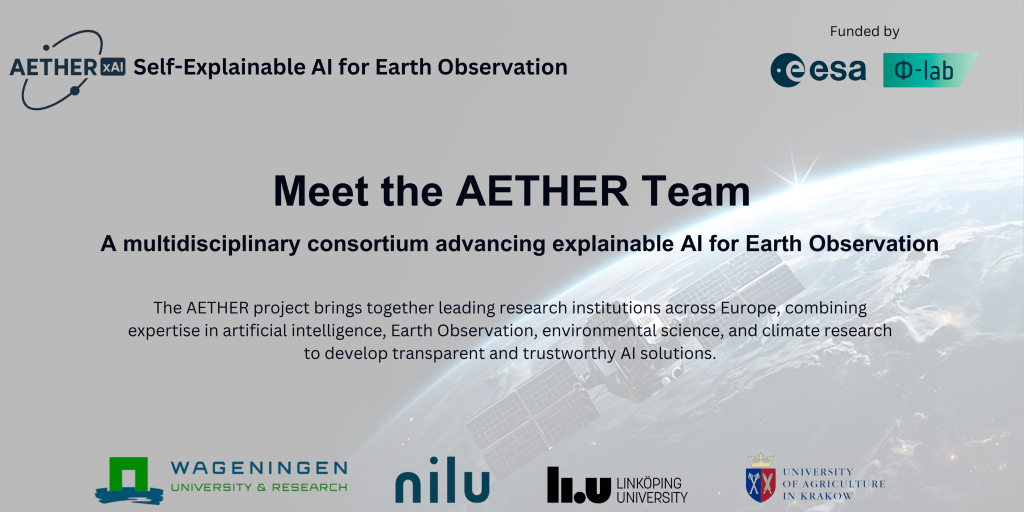
The AETHER project (AI for Earth Transparency with Human Explainable Reasoning) brings together a multidisciplinary consortium of research institutions working at the intersection of artificial intelligence, Earth Observation, climate science, and environmental modelling. Together, the partners are developing new methods to make AI systems for Earth Observation more transparent, interpretable, and trustworthy.
Check out our ABOUT US page to see the faces of colleagues behind the scenes. The consortium combines expertise from Wageningen University & Research (WUR), Linköping University (LiU), the Agricultural University in Kraków (URK), and the Climate and Environmental Research Institute (NILU), with the project funded by the European Space Agency (ESA).
Wageningen University & Research (WUR), The Netherlands
WUR coordinates the AETHER project and leads several core work packages related to project management, communication, and methodological development. Researchers from Wageningen Research (WR) and Wageningen University contribute expertise in Earth Observation analytics, environmental modelling, and explainable AI, supporting the development of the project’s self-explainable AI (S-xAI) framework and ensuring that datasets across use cases are harmonised and AI-ready.
Linköping University (LiU), Sweden
LiU leads the Crop Yield Prediction use case, focusing on agricultural systems across several countries in East/Southern Africa. The team develops AI models that integrate Earth Observation data with environmental and socio-economic indicators to better understand yield variability and support early warning systems for food security and climate adaptation.
Agricultural University in Kraków (URK)
URK leads the Urban Heat Island (UHI) use case. Using satellite observations, LiDAR data, and urban geospatial datasets, the team investigates how urban structures, vegetation, and topography influence local temperature patterns. These insights will support the development of explainable AI models for identifying urban heat hotspots and guiding climate-resilient city planning.
The climate and environmental research institute (NILU)
NILU contributes expertise in Earth Observation data integration, climate modelling, and AI development. The institute supports multiple work packages, including model development and validation, helping ensure that the AETHER framework can operate across different environmental applications.
Three Use Cases, One Explainable AI Framework
AETHER demonstrates its methodology through three real-world use cases:
- Urban Heat Islands: understanding and predicting temperature patterns in cities to support climate adaptation
- Crop Yield Prediction: improving yield forecast explanation and grounding for cereal crops in East/Southern Africa
- Biodiversity Monitoring: modelling species occurrence rates from EO data for butterfly and bird species.
Together, these applications illustrate how self-explainable AI can bridge the gap between complex machine learning models and practical decision-making.
As the project progresses, the consortium will continue to share updates on datasets, models, and insights emerging from this collaboration.