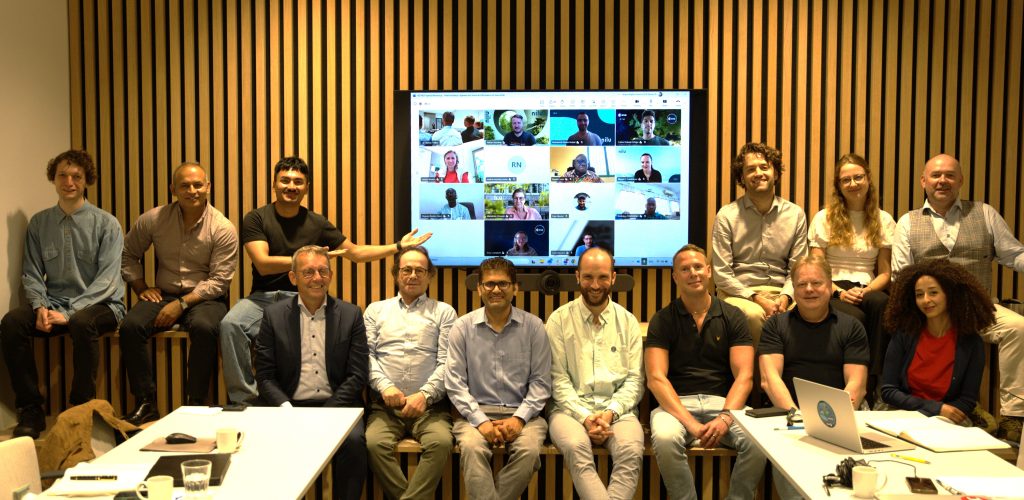
On 4 June 2026, the AETHER project hosted its Hybrid End-User Workshop on Wageningen Campus, with participants joining both in person and online. The workshop brought together AETHER consortium partners, ESA colleagues, and end users from the project’s core application areas to discuss progress, exchange feedback, and strengthen collaboration around self-explainable AI for Earth Observation.
The workshop opened with welcome remarks from Maciej Soja, AETHER Project Manager at Wageningen Environmental Research, who introduced the project’s objectives, agenda, and the importance of end-user engagement in shaping practical and trustworthy AI solutions. André van Lammeren, Managing Director of Wageningen Environmental Sciences Group, welcomed participants to Wageningen and highlighted the importance of projects such as AETHER in demonstrating WUR’s expertise in Earth Observation, environmental science, and the translation of research into societal impact. Mounia El Baz, ESA Technical Officer for AETHER from ESA Φ-lab, reflected on ESA’s role in supporting innovation in Earth Observation and the relevance of transparent, explainable AI for future EO applications.
Following the opening session, the consortium presented the AETHER self-explainable AI architecture, which combines prediction, alignment, and inference components to make AI-driven Earth Observation outputs more transparent and interpretable.
Dedicated use case sessions focused on crop yield prediction in East Africa, biodiversity monitoring in the UK, and urban heat island analysis in Kraków and Guatemala City. These sessions provided an opportunity to discuss user needs, data requirements, model development, and the practical relevance of explainable AI for decision-making.
A key part of the workshop was the presentation of the AETHER proof-of-concept platform. The platform aims to connect project outputs, model results, explanations, and user feedback in an accessible way. End users were invited to provide input on usability, explainability, multilingual accessibility, and the type of information needed to support real-world decisions.
Discussions throughout the day highlighted the importance of trustworthy AI, transparent explanations, spatial and temporal resolution, and the responsible communication of AI-ready datasets in line with FAIR principles.
The workshop concluded with reflections on the project roadmap, expected impact, and opportunities for continued collaboration. Feedback collected during and after the workshop will support the next phase of AETHER’s methodological development, platform refinement, and use case validation.


